
IRRMAP

IRRigation and Moisture Analytics for Prediction Dataset
The IRRMAP Dataset contains information about soil moisture, irrigation amount, rainfall, evapotranspiration, crop coefficient, humidity, wind speed, and solar radiation over 5000 days, considering a seasonal climate to mimic a South European environment. The dataset can be used to develop systems that autonomously predict soil moisture content and irrigation amount using neural network models.
IRRMAP is meant to support data-driven modeling, particularly for applications in precision irrigation and deep learning-based water management systems, as it integrates the main physical processes and information that influence soil moisture and irrigation variability.


HARMA

Human-cobot collaboration for Action Recognition in Manufacturing Assembly Dataset
The HARMA dataset is composed of multi-modal data regarding actions performed by different subjects, in collaboration with a Cobot in an assembly scenario for manufacturing. It has been collected to provide a good test-bed for developing, validating, and testing techniques and methodologies for the segmentation and recognition of assembly actions.
The HARMA dataset provides four types of simultaneous data: RGB frames, Depth maps, RGB-to-depth-Aligned (RGB-A) frames, and Skeleton data.


HA4M
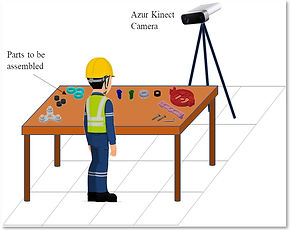
Human Action Multi-Modal Monitoring in Manufacturing Dataset
The HA4M dataset is a collection of multi-modal data relative to actions performed by different subjects in an assembly scenario for manufacturing. It has been collected to provide a good test-bed for developing, validating, and testing techniques and methodologies for the recognition and segmentation of assembly actions.
The HA4M dataset provides a considerable variety of multi-modal data compared to existing datasets. Six types of simultaneous data are supplied: RGB frames, Depth maps, IR frames, RGB-Depth-Aligned frames, Point Clouds, and Skeleton data.


SPPB

Short Physical Performance Battery Dataset
A complete dataset composed of sex, age, skeletal information, and evaluation of patients (both healthy and affected by neurodegenerative diseases) performing the Short Physical Performance Battery (SPPB) tests is presented. Subjects have been grabbed by a system of three low-cost surveillance cameras. Then, proper video processing techniques were used to highlight the skeletal joints of the subjects.
